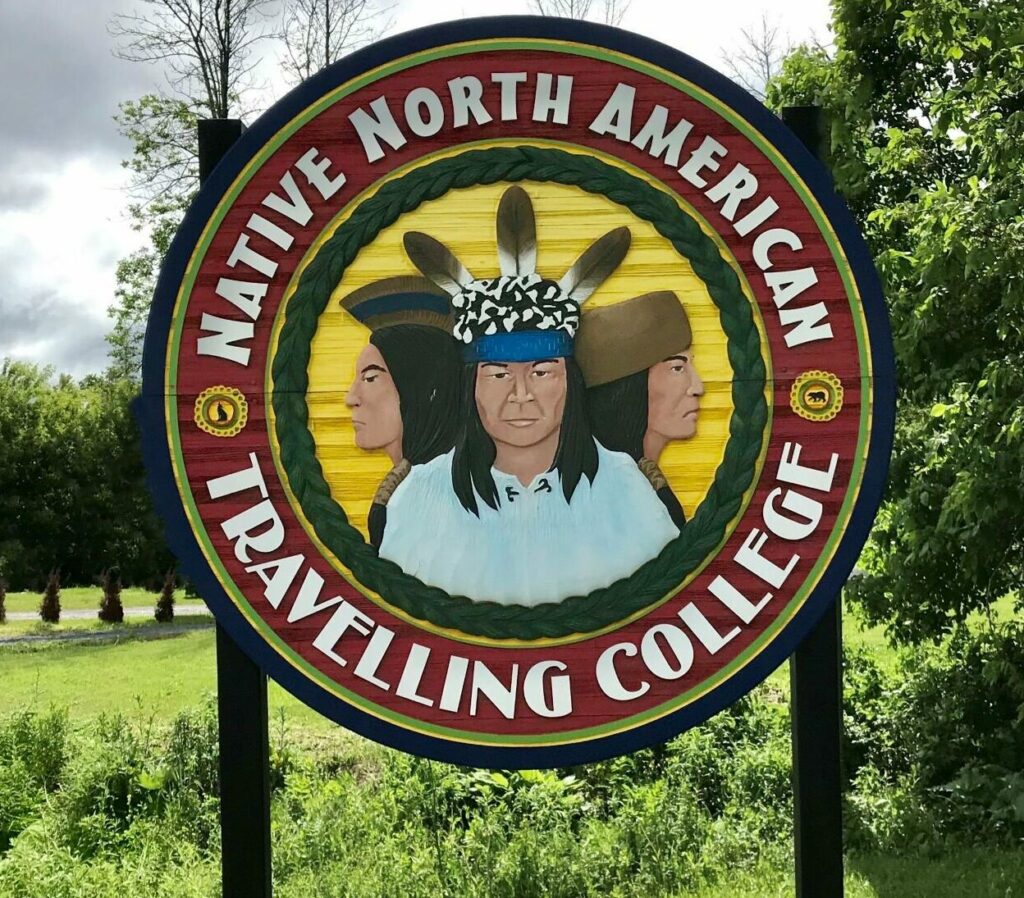
Located on the Mohawk Territory at Akwesasne, the Native North American Travelling College is dedicated to preserving and maintaining Kanienkehaka (Mohawk) culture and language.
The concept of the Native North American Travelling College began in the 1960s with a dream, a Volkswagen van and a visionary leader: Dr. Ernest (Ernie) Kaientaronkwen Benedict. Ernie was dedicated to traditional teachings and education for the wellbeing of Indigenous people. He believed in the power of teaching and dispelling the misconceptions of colonial-led history.
“…We need to help our children grow up with new knowledge and old wisdom. We must do those things if our people are to live.” (Ernest Benedict 1968).
The objectives of the Native North American Travelling College (NNATC) are to reach the people, inform them and give them a better understanding of our culture and heritage. Efficiency, determination and commitment are some of the key words used to describe the College in reaching these goals. From these efforts, the general public stands to gain knowledge and appreciation of Indigenous Peoples and their many unique characteristics.
At the forefront of cultural education and revitalization since 1966, NNATC’s early beginnings started as a mobile Travel Troupe across North America. In 1974, NNATC found a base in Akwesasne on Kawehnoke (Cornwall Island, ON).
In the summer of 1974, the College formed ONAKE Corporation, a not-for-profit organization under which the Travelling College still operates. Ernie served as the board of directors’ first president to guide the Travelling College. With funding, the Travelling College leased and renovated an old farmhouse for its first headquarters. Over the years, several changes to the College’s name reflected contemporary naming practices and priorities, including the Native American Indian Travelling College, the Ronathahonni Cultural Centre, and now its current name, the Native North American Travelling College.
The Native North American Travelling College is well-established as the centre for Haudenosaunee cultural knowledge with a focus on Akwesasne Mohawk Territory where the fire for the Mohawk Nation is maintained.